
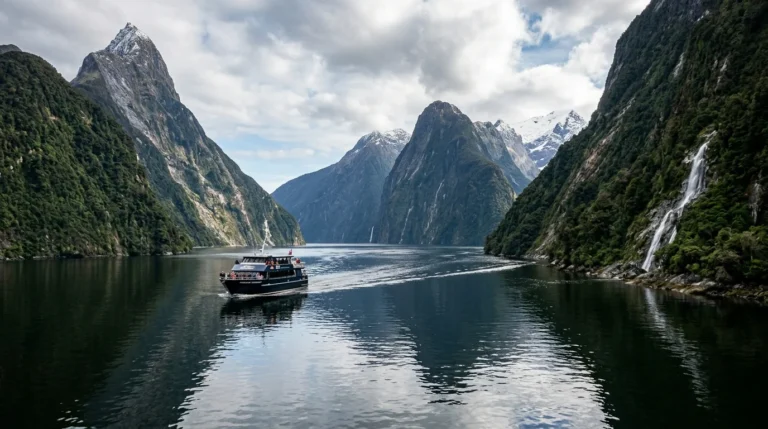
Fiordland National Park covers 1.2 million hectares of New Zealand’s south-west corner and contains 14 named fjords carved by ancient glaciers. The park is part of Te Wāhipounamu, the UNESCO World Heritage Area that stretches along the South Island’s west coast. Cruising is the main way to see the fjords. You can choose between day cruises and overnight trips on Milford Sound and Doubtful Sound, with boats ranging from small vessels to large catamarans.
Milford Sound Cruises
Milford Sound is the most accessible fjord in Fiordland. RealNZ is one of the largest operators, running multiple vessels including catamarans and the overnight Milford Mariner. Other day cruise operators include Southern Discoveries, Pure Milford, Cruise Milford and Mitre Peak Cruises.
Day cruises typically last between 1 hour 45 minutes and 2 hours. You sail the length of the fjord from the terminal to the Tasman Sea and back, passing waterfalls including Stirling Falls and viewing Mitre Peak from the water. Southern Discoveries also operates the Milford Sound Underwater Observatory, where you can descend below the surface to see black coral and marine life.
Cruise Milford limits each departure to 75 passengers on boats surveyed for 150, creating a less crowded experience than the larger vessels. Pure Milford operates newer catamarans with glass roofs. Mitre Peak Cruises runs smaller boats.
Milford Sound Overnight Cruises
RealNZ operates overnight cruises on the Milford Mariner. The trip includes dinner, accommodation in private cabins and breakfast. You can kayak on the fjord and explore by tender craft. The overnight experience lets you see Milford Sound at sunset, after dark and at sunrise when day cruise boats have not yet arrived.
The Milford Mariner departs from the Milford Sound terminal in the late afternoon and returns the following morning. Coach transfers are available from Queenstown and Te Anau.
Doubtful Sound

Doubtful Sound is larger and deeper than Milford Sound, with three times the length and more remote inlets. RealNZ is the main operator on Doubtful Sound at this scale, and no other operator runs overnight cruises on the sound at equivalent frequency.
To reach Doubtful Sound your tour begins in Manapouri. You take a boat trip across Lake Manapouri and a bus trip over Wilmot Pass to get into Doubtful Sound itself. There is no road connection to the outside network.
RealNZ runs a three-hour day cruise and an 18-hour overnight cruise from Deep Cove. The overnight boats are the Navigator and Wanderer. Day cruises depart from Manapouri and include the boat and bus transport. Overnight cruises follow the same access route, with departures from Queenstown, Te Anau or Manapouri.
Wildlife
Fiordland’s fjords support bottlenose and common dolphins, New Zealand fur seals, and several penguin species. You might see Fiordland crested penguins along rocky shores during breeding season. Birdlife includes the kea, an alpine parrot, and the rare takahē, a large flightless bird. The forests and cliffs around the fjords are home to diverse native species.
Keep a respectful distance from wildlife. Do not feed animals as this disrupts their natural behaviour. Most cruise operators provide commentary about the species you encounter and follow Department of Conservation guidelines for wildlife viewing.
Getting There
Te Anau is the main base for Fiordland. It sits on the eastern side of the park, two hours from Queenstown. From Te Anau it is 120 kilometres to Milford Sound along the Milford Road, a winding highway through mountains and rainforest. The drive takes around two hours.
Most cruise operators offer coach packages from Queenstown or Te Anau that include transport and the cruise. Some also offer fly-cruise options with scenic flights. You can drive yourself to Milford Sound, where there is a large car park at the cruise terminal. Doubtful Sound has no direct road access.
If you are driving in winter carry chains and check road conditions before you leave. The Milford Road can close due to avalanche risk or snow.
When to Visit
Summer (December to February) has the longest days and mildest weather, with temperatures between 15°C and 25°C. This is peak season. Boats are busier and you need to book well ahead.
Autumn (March to May) and spring (September to November) have fewer visitors and often good weather. Autumn brings changing foliage colours. Spring sees increased bird activity and newborn seal pups on the rocks.
Winter (June to August) is quiet with dramatic snow-capped peaks, but some cruise services run reduced schedules and weather can be challenging. Fiordland receives heavy rainfall year-round, often several metres annually, so waterfalls are impressive in any season.
What to Bring
Weather in Fiordland changes quickly. Pack layers including a warm fleece or wool jumper. A waterproof jacket is essential. Even on sunny days, rain can arrive without warning. Wear sturdy walking shoes with good grip for moving around the boat and any shore excursions.
Bring sun protection including sunglasses, a hat and sunscreen. The sun reflects off the water. If you are prone to seasickness, take medication before boarding. Bring binoculars for spotting wildlife and distant waterfalls. A camera with extra batteries and memory cards will help you capture the scenery.
For overnight cruises pack light. Cabins have limited storage. Bring personal toiletries, medications and a change of clothes. Most overnight boats provide bedding and towels.
Sustainable Tourism
Fiordland is a protected area within a World Heritage site. Cruise operators work within Department of Conservation permits that limit vessel numbers and set environmental standards. Many companies use low-emission technologies and support conservation projects.
You can minimise your impact by staying on marked paths during any land excursions, taking all rubbish with you, and avoiding single-use plastics. Do not disturb vegetation or wildlife. If you kayak, maintain distance from seal colonies and penguin nesting sites.
Choose operators with strong environmental credentials and support businesses that contribute to conservation efforts in the region. More information on visiting Fiordland responsibly is available on the Department of Conservation website.
Planning Your Trip
Book cruises in advance, particularly in summer and during school holidays. Compare operators based on vessel size, departure times and what is included. Larger boats have more facilities but can feel crowded. Smaller vessels offer a more intimate experience but may have less shelter in poor weather.
If you have limited time, Milford Sound is easier to reach and has more frequent departures. If you want a quieter experience, consider Doubtful Sound or an overnight cruise. Combining a day cruise on one fjord with an overnight on the other gives you a fuller picture of Fiordland.
For more cruise options around New Zealand, see our guides to wine and cruise experiences and Māori culture and cruising. You can also explore other parts of Southland and Otago while you are in the south.
FAQ
Do I need to book Fiordland cruises in advance?
Yes, especially between November and March. Popular cruises and overnight trips fill up weeks ahead during peak season. Booking early also gives you better choice of departure times and vessel types.
Which is better, Milford Sound or Doubtful Sound?
Milford Sound is more dramatic and easier to access, with towering cliffs and frequent waterfalls. Doubtful Sound is larger, quieter and more remote, offering a wilderness feel. If you have time, visit both.
What if it rains during my cruise?
Rain is common in Fiordland and creates spectacular waterfalls. The fjords are impressive in wet weather. Modern cruise vessels have covered viewing areas. Bring waterproof clothing so you can still go on deck.
Sources
- Department of Conservation: Te Wāhipounamu World Heritage Area
- RealNZ: Milford Sound and Doubtful Sound cruises
- Department of Conservation: Fiordland National Park

Independent New Zealand travel guides from 0 Digital, Aotearoa New Zealand. Details change, so check with the operator or the official source before you go. Spotted something out of date? Tell us.
 Beaches and islands
 Beaches and islands
 Beaches and islands
