
New Zealand has one of the world’s best-preserved collections of Art Deco architecture, concentrated in Hawke’s Bay. The 1931 Hawke’s Bay earthquake, measuring 7.9 on the Richter scale on 3 February 1931, destroyed most of Napier’s commercial centre, and also levelled nearby Hastings. The earthquake killed 256 people and was the worst natural disaster in New Zealand’s history. The city was rebuilt rapidly between 1931 and 1933, predominantly in the Art Deco and Spanish Mission styles fashionable at the time.
Napier
Napier and South Beach, Miami, Florida, are considered to be the two best-preserved Art Deco towns. The 1931 earthquake raised some 4,000 hectares of seabed within the city, creating new land that was later developed. Napier’s architects chose to adopt the Art Deco style because it was fashionable and its simplicity and clean lines suited the holistic, safety-focused approach the rebuild required.
The Art Deco Trust in Memorial Square is the best place to start exploring Napier’s unique architecture. The Art Deco Centre offers daily guided tours, and the Art Deco Trust brings the city’s heritage to life through Art Deco Festival Napier in February and Winter Deco in July. Watch the earthquake movie The Day That Changed the Bay to discover how the 1931 earthquake transformed Napier.
Walking tours take you past buildings displaying geometric patterns, sunburst motifs, zigzags and fountain designs typical of the period. Some buildings also incorporate Egyptian and Central American influences popular in Art Deco design.
Hastings Art Deco Heritage
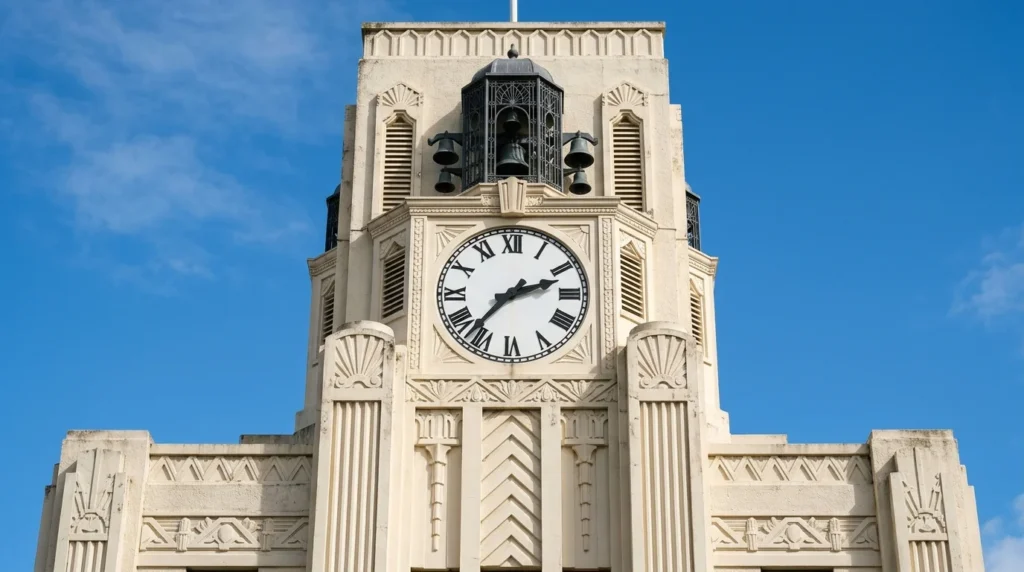
Hastings, 20 kilometres inland from Napier, suffered extensive damage in the same earthquake. There are more Art Deco buildings in Hastings than Napier, though they receive less attention. Fashionable architectural styles of the time were Stripped Classical, Spanish Mission, Art Deco and Moderne, which lent themselves admirably to the low-rise form and the materials – reinforced concrete with plaster finish – that became prevalent after the earthquake.
The Hastings Clock Tower was commissioned as a symbol of triumph over adversity to commemorate the rebuild of Hastings following the 1931 Hawke’s Bay earthquake. The Hastings Clock Tower is an excellent example of mid-1930s Art Deco Moderne and is registered as a Category 1 heritage building.
Most heritage buildings in Hastings are within the central business district, and the streets that have most of them are Queen Street West, Heretaunga Street West, and Russell Street. The Opera House and Westerman’s are nationally important examples of the Spanish Mission style, the Clock Tower of the Art Deco style, and the Hawke’s Bay Farmers Building of the Stripped Classical style.
Art Deco Festival
Every February, Napier comes alive with the world-famous Art Deco Festival. This unique festival attracts 40,000+ participants from all over New Zealand and around the world. Over four days, Napier fills with vintage fashion, classic cars, live music, street entertainment and standout events across the city, all set against one of the world’s most complete Art Deco backdrops.
The festival runs in mid-February each year. Events include vintage car parades, guided architectural tours, fashion shows and live jazz performances that recreate the atmosphere of the 1920s and 1930s.
Find more heritage experiences in our Culture and heritage listings.
Wellington Art Deco Buildings
Wellington has several notable Art Deco buildings integrated into its urban landscape. The Embassy Theatre is New Zealand’s grandest picture palace. Originally built in 1924, the Embassy was designed with elements of Art Deco, Gothic and Classical Style architecture. The theatre was fully refurbished in 2003 for the world premiere of The Lord of the Rings: The Return of the King.
Many original Art Deco features remain including a grand marble staircase and intricate plastered ceilings. The theatre is located at 10 Kent Terrace in Mount Victoria and continues to host film premieres and cultural events.
Explore more of the capital in our Wellington region guide.
Auckland Art Deco Buildings
Auckland has fewer Art Deco buildings than Napier or Hastings, but the Civic Theatre stands out as a significant example. Completed in 1929, the Civic features elaborate Art Deco interior design with vibrant colours and intricate detailing. The theatre remains an entertainment venue and architectural landmark in central Auckland.
Other Art Deco structures can be found scattered through the central city, though many have been modified or demolished over the decades as Auckland developed.
Plan your visit to the region with our Auckland guide.
Planning Your Visit
Napier and Hastings are in the Hawke’s Bay region on the east coast of the North Island. The area is accessible by road from Wellington (330 kilometres south) or from other North Island centres. Napier has an airport with domestic flights.
Self-guided walks allow you to explore at your own pace, or join organised tours for detailed historical context. The Art Deco Trust offers daily walking tours departing from their centre in Memorial Square.
Hawke’s Bay is also known for its wineries and warm, sunny climate. Consider combining your Art Deco exploration with wine tasting or visits to nearby Cape Kidnappers.
Browse Places to stay and Tours and sightseeing for accommodation and tour options.
FAQ
Why does Napier have so much Art Deco architecture?
The 1931 Hawke’s Bay earthquake destroyed most of central Napier. The city was rebuilt quickly in 1931-1933 using Art Deco and Spanish Mission styles, which were fashionable at the time and suited earthquake-resistant reinforced concrete construction.
When is the Art Deco Festival?
The Art Deco Festival takes place every February in Napier, running over four days in mid-February. The festival celebrates the city’s architectural heritage with vintage fashion, classic cars, music and cultural events.
Are there Art Deco buildings in other New Zealand cities?
Yes. Wellington has the Embassy Theatre and other Art Deco buildings, while Auckland has the Civic Theatre. However, Napier and Hastings have the largest and most cohesive collections of Art Deco architecture in New Zealand.
Sources
- Napier City Council – Art Deco Capital
- Art Deco Napier – Art Deco Trust
- Heritage New Zealand – Embassy Theatre
- Hastings District Council

Independent New Zealand travel guides from 0 Digital, Aotearoa New Zealand. Details change, so check with the operator or the official source before you go. Spotted something out of date? Tell us.
 Culture and heritage
 Culture and heritage
 Culture and heritage
